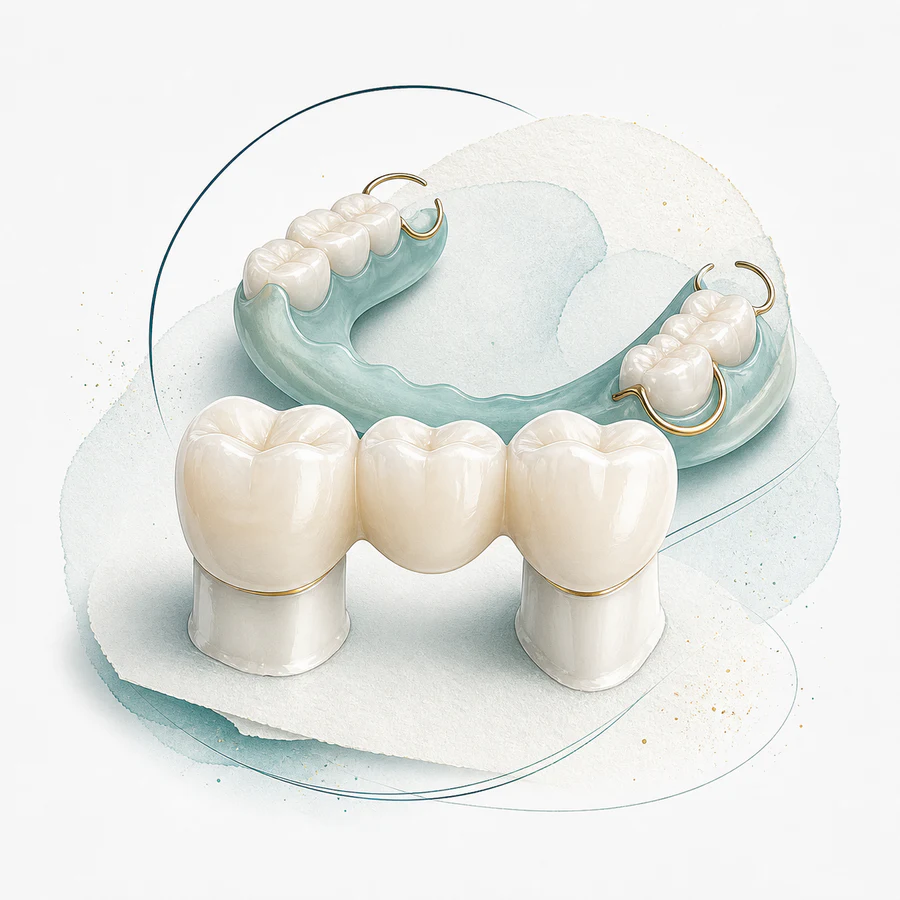
Crowns rebuild selected damaged teeth, while bridges and dentures replace missing teeth in different ways. Assessment considers the teeth and gums, the number and position of gaps, the bite, cleaning needs and patient preferences.
Assessment first. Suitability is determined after an examination and any appropriate diagnostic records.
When might this treatment be considered?
These examples are general and cannot diagnose the cause of a concern.
A weakened or heavily restored tooth may benefit from full coverage.
One or more missing teeth need a fixed replacement option to be assessed.
Several missing teeth need a removable partial denture option.
All teeth in an arch are missing and a complete denture is being considered.
An existing denture needs assessment for fit, function or replacement.
Treatment options
The most appropriate option depends on clinical findings, priorities and informed discussion.
Crown
A crown covers and rebuilds a selected tooth when sufficient support and a full-coverage restoration are appropriate.
Bridge
A fixed bridge replaces a gap using a design supported by suitable neighbouring teeth or implants.
Partial denture
A removable appliance replaces some missing teeth and may use acrylic, metal or a combination depending on the design.
Complete denture
A removable denture replaces the teeth in a full upper or lower arch.
Implant-supported denture
Implants may add retention to a removable denture when implant treatment is suitable.
Services listed in this category
Crowns
Bridges
Partial dentures
Complete dentures
Cast partial dentures
Implant-supported dentures
Assessment and diagnosis
A consultation helps the dentist understand the concern and identify appropriate next steps.
01
Examination of remaining teeth, gums, supporting tissues and bite.
02
Discussion of eating, speaking, appearance, comfort and cleaning priorities.
03
Digital dental X-rays where needed to assess supporting teeth or planned treatment.
04
Evaluation of any existing crown, bridge or denture.
05
Comparison of fixed, removable and implant-supported options where relevant.
Treatment journey
What the process may involve
01
Assessment
The dentist identifies which teeth can support treatment and what the missing-tooth space requires.
02
Choose an approach
Fixed, removable and implant-supported options are compared for suitability, maintenance and budget.
03
Prepare and record
The required tooth preparation and measurements are completed for the agreed restoration.
04
Fit and adjust
The crown, bridge or denture is checked for fit, bite, appearance and comfort.
05
Adapt and review
The mouth is reviewed and adjustments are made where clinically appropriate.
Potential benefits and important considerations
Potential benefits
May restore damaged tooth form or replace missing teeth.
Can support chewing, speech and appearance depending on the option.
Offers fixed and removable choices for different situations.
Can be planned around cleaning ability, remaining teeth and budget priorities.
Limitations and considerations
Supporting teeth and gums must be suitable for the chosen design.
Crowns and conventional bridges involve preparation of selected teeth.
Dentures are removable and usually require an adaptation period.
The mouth changes over time, so adjustment, repair or replacement may become necessary.
Comfort, function and longevity cannot be guaranteed.
Recovery or adaptation
A prepared tooth may feel temporarily sensitive after crown or bridge treatment.
New dentures can initially affect speech, eating and sore areas while the mouth adapts.
Persistent pain, movement, fracture or sore spots should be reviewed rather than tolerated.
Treatment length and recovery vary according to clinical complexity and individual response. Follow the advice given for your own care.
Aftercare
Clean around crowns and under bridges using the method shown by the dental team.
Remove and clean dentures as instructed, and care for the mouth underneath them.
Do not attempt to adjust or repair a restoration at home.
Attend reviews for the restoration, supporting tissues and remaining teeth.
Frequently asked questions about crowns, bridges & dentures
The choice depends on the number and position of missing teeth, suitable support, oral health, cleaning, preferences and budget. An examination is needed.
A crown may be considered when a tooth is significantly weakened, damaged or restored, but enough support remains for a full-coverage restoration.
Adaptation varies. Speaking, eating and comfort can take time, and review appointments may be needed for adjustments.
Follow the individual instructions provided for your denture and oral tissues. The dental team will explain removal, storage and cleaning.
Longevity varies with the design, materials, supporting tissues, bite, habits, cleaning and maintenance. No fixed lifespan can be promised.