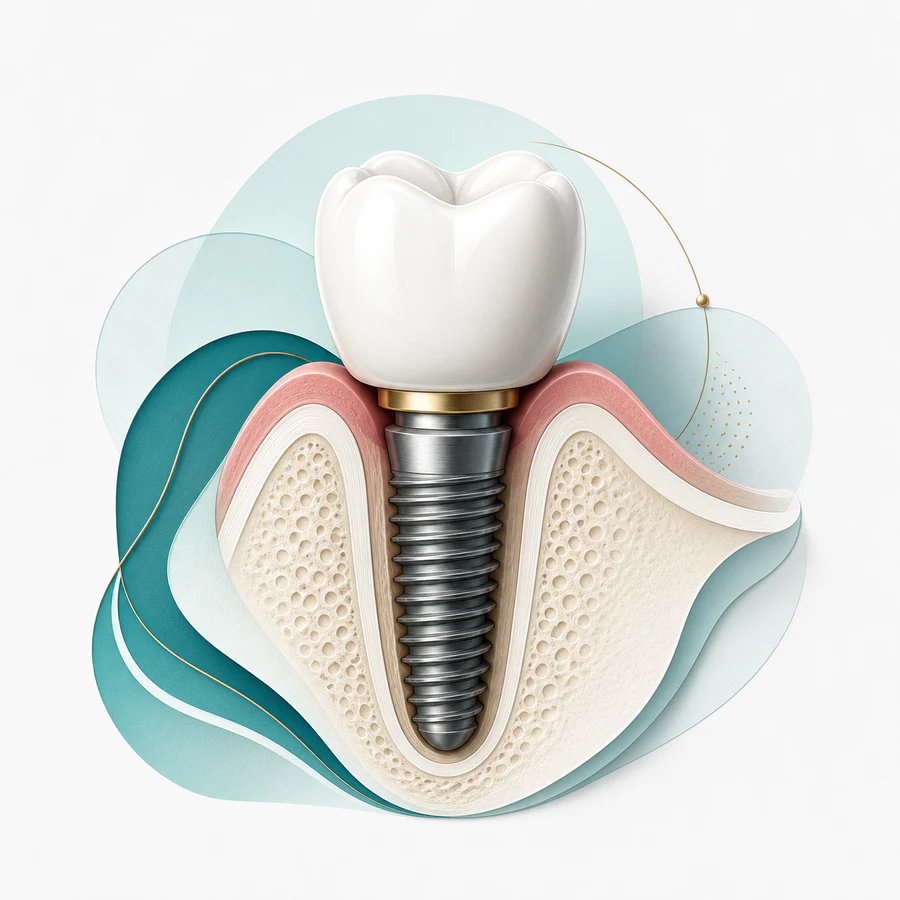
Dental implants can support a crown, bridge or denture when one or more teeth are missing. Planning begins with an examination and appropriate imaging because the most suitable option depends on oral health, available support and individual priorities.
Assessment first. Suitability is determined after an examination and any appropriate diagnostic records.
When might this treatment be considered?
These examples are general and cannot diagnose the cause of a concern.
One tooth is missing and an implant-supported crown may be suitable.
Several teeth are missing and a fixed or removable implant-supported option is being explored.
A complete denture needs additional support, subject to assessment.
A patient wants to compare implant treatment with bridges or removable dentures.
Treatment options
The most appropriate option depends on clinical findings, priorities and informed discussion.
Single-tooth replacement
An implant may support an individual crown without using neighbouring teeth for support, where clinically appropriate.
Implant bridges for multiple missing teeth
A planned number of implants may support replacement teeth when several teeth are missing.
Conventional two-stage treatment
Implant placement and the final replacement tooth are completed in planned stages, allowing time for healing and review.
Immediate-loading approach
A temporary tooth may sometimes be connected earlier, but this is not suitable for every site or patient.
Implant-supported dentures
Implants may help retain a removable denture when the mouth and supporting structures are suitable.
Full-mouth rehabilitation
All-on-X treatment may be considered to rehabilitate an upper jaw, lower jaw or both jaws after complete clinical and radiographic assessment.
Bone and soft-tissue grafting
Bone grafting, guided bone regeneration (GBR), or soft-tissue grafting may be included when the assessed implant site requires additional support.
Services listed in this category
Immediate-loading implant treatment where clinically appropriate
Conventional two-stage implant treatment
Implant-supported dentures
Single implants to replace one missing tooth
Implant bridges to replace multiple missing teeth
Full-mouth rehabilitation of the upper and lower jaws using All-on-X treatment
Bone grafting, guided bone regeneration (GBR), and soft-tissue grafting when indicated
Assessment and treatment planning
Assessment and diagnosis
A consultation helps the dentist understand the concern and identify appropriate next steps.
01
Discussion of the missing tooth or teeth, current concerns and treatment goals.
02
Review of relevant medical and dental history and current medicines.
03
Examination of the teeth, gums, bite and proposed implant area.
04
Digital dental X-rays where clinically indicated; any further imaging needs are discussed before treatment.
05
Comparison of implant treatment with appropriate bridge or denture alternatives.
Treatment journey
What the process may involve
01
Consultation
The dentist examines the mouth, reviews relevant history and listens to the patient’s priorities.
02
Diagnostics and planning
Appropriate records and imaging help assess the site and shape a proposed treatment plan.
03
Discuss options and consent
Expected stages, alternatives, limitations, risks, aftercare and fees are discussed before consent.
04
Planned treatment stages
Placement, healing, review and restoration take place in the sequence suitable for the individual case.
05
Maintenance
Ongoing home care and review appointments support the surrounding gums, replacement teeth and remaining natural teeth.
Potential benefits and important considerations
Potential benefits
May provide a fixed or better-supported replacement for missing teeth.
Can help restore chewing function and the appearance of a gap.
Allows single- and multiple-tooth options to be considered.
Can be planned alongside the health of the remaining teeth and gums.
Limitations and considerations
Implants are not suitable for every patient or every missing-tooth site.
Treatment involves a surgical stage and a commitment to follow-up and daily cleaning.
Healing and the overall treatment length vary with clinical complexity and individual response.
Additional procedures may sometimes be required; these must be assessed and discussed individually.
No implant treatment can be presented as permanent or guaranteed.
Recovery or adaptation
The treated area may feel tender or swollen after a surgical stage; the individual care plan explains what to expect.
Eating and cleaning instructions depend on the procedure and the temporary restoration, if used.
Contact the treating clinician if symptoms are severe, worsening or different from the advice provided.
Treatment length and recovery vary according to clinical complexity and individual response. Follow the advice given for your own care.
Aftercare
Follow the personalised cleaning instructions for the implant, restoration and surrounding gums.
Attend planned reviews so healing and the bite can be checked.
Avoid using the implant or temporary tooth outside the limits explained by the dentist.
Maintain routine care for the remaining natural teeth and gums.
Frequently asked questions about dental implants
No. Suitability depends on the condition of the mouth, the proposed implant site, relevant health factors, expectations and ability to maintain the area. An examination and appropriate imaging are required.
No. An immediate-loading approach is considered only when clinical conditions allow it. A staged approach may be safer or more predictable for some patients.
Treatment length varies according to clinical complexity, the number and position of implants, healing and whether any additional procedures are needed.
Depending on the mouth and the number of missing teeth, alternatives may include a bridge, partial denture or complete denture. The dentist will explain suitable choices after assessment.
Yes. Implant-supported teeth and the surrounding gums need daily cleaning and professional review, alongside care of the remaining natural teeth.